
Frequently Asked Questions
-
The site is located on land near Main Road, Brailsford, Ashbourne DE6 3DA.
-
The cost of living crisis, the war in Ukraine, and the climate crisis are all linked by how we generate, use and supply energy. National energy independence is key to supporting British economic growth. We urgently need to generate energy from new, low-cost, low-carbon sources, and solar is the lowest-cost and quickest to deploy of all energy sources. It is currently one-ninth the cost of gas and less than one-third of the cost of nuclear.
Solar power is already yielding tangible results. In 2024, electricity generation from solar PV amounted to 14.8 Terawatt-hours (TWh). A TWh is equivalent to a trillion-watt hours. This was around 10% of renewable electricity generated and 5% of total electricity generated in the UK.
Solar power is a core part of the Government’s Net Zero target, and to achieve the Government’s ambition in the Clean Power 2030 Action Plan, the total operational capacity of renewables will need to more than double by 2030 (According to the Climate Change Committee’s 2025 Report to Parliament).
Achieving this objective requires the deployment of larger scale solar farms as well as on the rooftops of industrial and residential buildings.
-
Assist Derbyshire Dales District Council in reducing greenhouse gas emissions in line with local targets.
Generate a secure and stable supply of electricity to help meet the Government's target of net zero by 2050.
Contributes to national energy independence by expanding British energy production capabilities, safeguarding the nation against geopolitical pressures.
Generates Business Rates for the local council, creating extra revenue to support council-run community services.
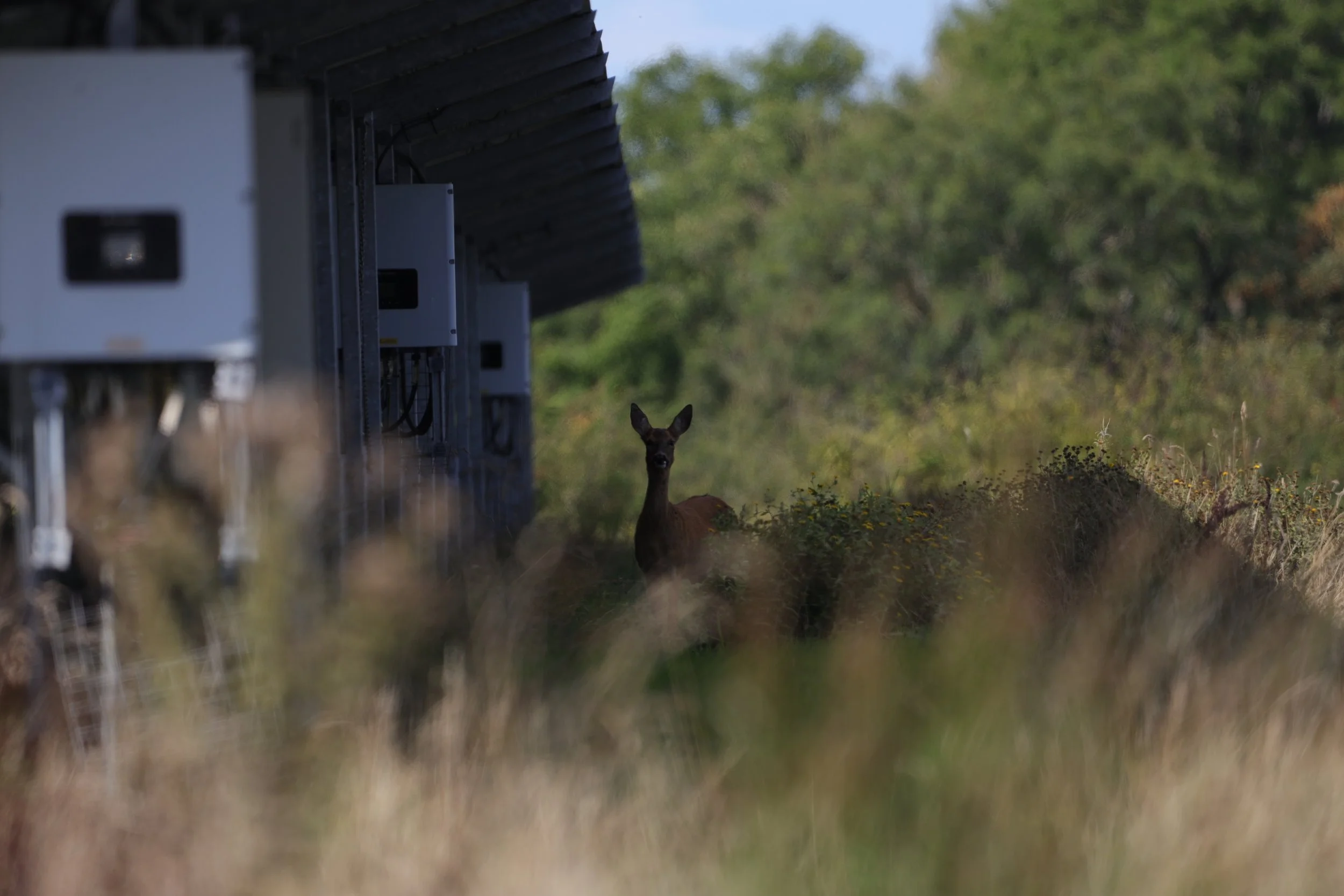
Delivers a biodiversity net gain of at least 60%, exceeding the 10% minimum, through measures such as planting new hedgerows, filling gaps in existing ones, and establishing wildflower meadows.
This is a temporary scheme with a 40-year lifespan, after which all infrastructure will be removed and the land returned to agricultural use; decommissioning is secured through planning conditions.
Because the site will only be used temporarily, the fallow period created by hosting solar panels will help restore soil health and enhance its condition for future agricultural use.
-
If you have any questions about the proposals or need to speak with a member of the project team, please do not hesitate to get in touch with us by:
1) Email us at:
contact@brailsfordsolarpark.com
2) Fill in the feedback form on this website.
This feedback form can be found here.
3) Phone us at:
-
The solar park would have an operational lifespan of 40 years. Following this, the Solar PV arrays would be decommissioned, and the land can be returned to agricultural use.
-
Ecological enhancements to the site will be achieved through maintaining existing hedgerows and surrounding vegetation, and the creation of wildlife grassland, thereby improving the existing landscape features in and around the site.
These measures will be explored in greater detail in collaboration with the Derbyshire Dales District Council throughout the consultation period.
-
There is currently an urgent need for alternatives to expensive, polluting fossil fuels in the UK. The need for renewable power across the UK is crucial for the UK’s future energy security.
The UK Food Security Report (2021) found that “the biggest medium to long-term risk to the UK’s domestic production comes from climate change and other environmental pressures like soil degradation, water quality and biodiversity”.
Government policy aims to have a Solar PV capacity of 70GW by 2035. Research by Carbon Brief suggests that reaching this goal will lead to solar farms taking up 0.3% of Britain’s land area. That is roughly 1/200th of the land used for agriculture and half the space taken up by golf courses.
In 2021 the Global Environmental Action NGO Waste and Resources Action Programme (WRAP), estimated that 10.7 million tonnes of food went to waste in the UK. Total food waste in the UK is equivalent to 25% of all food purchased. Highlighting that food waste, not land availability, is a more significant challenge to food security.